
Wuxi Huatong Pneumatic Manufacturing Co., Ltd.
HT. Pneumatic Manufacture
Pneumatic Cylinder_Wuxi Huatong Pneumatic Manufacturing Co., Ltd.
Pneumatic Cylinder - Wuxi Huatong Pneumatic Manufacturing Co., Ltd.
Wuxi Huatong Pneumatic Manufacturing Co., Ltd. Pneumatic Cylinder section provides the latest industry news and technical updates on pneumatic technology.
Source: Wuxi Huatong Pneumatic Manufacturing Co., Ltd. Official Website https://www.ht-drives.com
-

Wuxi Huatong Pneumatic QGS Series Cylinder – Mounting Options & Accessories
03-20QGS Series Cylinder Mounting Configurations:The QGS standard cylinder complies with ISO international standards for dimensions, mounting forms, and interfaces—ensuring reliable operation, durability, and interchangeability. Available mounting types:Unmarked = Basic typeMF1 – Head flange mountMF2 – Cap (rear) flange mountMS1 – Axial base mountMP2 – Rear detachable double clevis mountMP4 – Rear detachable single clevis mountMT4 – Intermediate trunnion (pivot) mountLZ – Piston rod clevis jointFC – Piston rod wiper boot
-

Custom Non-Standard Cylinders – Tailored to Your Exact Needs
07-03 -
Standard Operating Requirements for Pneumatic Cylinders
05-09(1) Normal Conditions: Medium and ambient temperature: –20 to +80°C; Working pressure: 0.1–1.0 MPa. Refer to specific product datasheets for exceptions.(2) Pre-Installation Test: Pressure test at 1.5× working pressure; no air leakage allowed.(3) Lubrication: Install an oil mist lubricator at the air inlet. Proper lubrication is critical—poor lubrication causes crawling or complete failure.(4) Mounting: Align actuation direction correctly. Piston rod must never bear eccentric or lateral loads.(5) Variable Loads: If load changes during stroke, select a cylinder with ample force margin and add external cushioning.(6) Stroke Limit: Avoid full stroke—especially on extension—to prevent piston-to-end-cap impact and component damage.
-
What to Check When Purchasing a Pneumatic Cylinder
05-09As the actuator in a pneumatic system, cylinder quality directly impacts equipment performance. Consider the following when selecting:1. Choose manufacturers with strong reputation, proven quality, and reliable service.2. Verify the production standard—compare enterprise standards against industry norms if applicable.3. Inspect appearance, leakage, and no-load performance:A. Appearance: Barrel and rod must be scratch-free; end caps free of porosity or sand holes.B. Leakage: No external leakage except at rod seal. Internal and rod-end external leakage must each be < (3 + 0.15D) mL/min (D = bore in mm).C. No-Load Test: Run cylinder unloaded at low speed; the lower the minimum speed without crawling, the better.
-
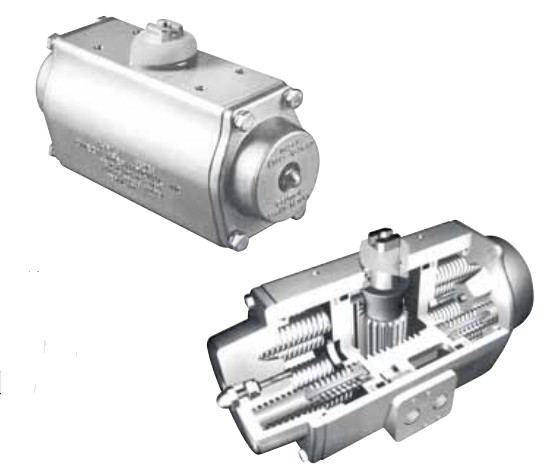
Key Features of 10SR/DA Pneumatic Rotary Actuators
04-09The 10SR/DA pneumatic actuator uses a dual-rack-and-pinion mechanism with an aluminum alloy body. SR = spring-return (single-acting); DA = double-acting. Bore: Φ45–Φ400 mm. Standard models offer ±4° adjustability at 0° and 90° positions. Max theoretical torque @ 0.8 MPa: DA = 15,800 N·m; SR (K6 spring) = 9,696 N·m @ 0°, 7,488 N·m @ 90°.Main Features:1) Dual-rack design increasingly adopted to boost torque or reduce size (vs. traditional single-rack).2) Materials: Body—aluminum with hard-anodized finish (stainless for corrosive media, electropolished). Pinion shaft—stainless steel. Racks—stainless or die-cast aluminum, with composite bearings and wear rings to reduce friction and extend life. Seals—NBR O-rings (standard), FKM for high-temp, low-temp NBR for cold. Integrated anti-leak, bearing-guided shaft design ensures longevity.3) Oil-free lubrication—low friction, high reliability.4) Magnetic switch compatible for automated control.5) Mounting complies with internati...
-
Consequences of Insufficient Machining Accuracy on Cylinder Performance
04-08Cylinder barrel bore requires high machining precision. Surface roughness depends on piston seal type: • O-ring seals: Grade 3 accuracy, Ra ≤ 0.4 μm • Y-ring seals: Grade 4–5 accuracy, Ra ≤ 0.4 μmCylindricity and roundness errors must not exceed half the dimensional tolerance. Perpendicularity between end face and bore must be within 2/3 of tolerance.If barrel surface finish is inadequate, friction between seal and bore increases, causing:• Elevated starting pressure• Crawling (jerky motion)• Accelerated seal wear → internal leakage → failure to meet performance specs.Prevention: Improve machining accuracy of barrel and rod surfaces.
-

Key Features of Compact (Thin) Pneumatic Cylinders
04-08Main features of compact cylinders: (1) Buffering: Small bore and short stroke → low impact → typically use elastomeric buffer pads. (2) Piston Sealing: Uses either custom-profile or C-shaped bidirectional seals with oil reservoirs—supports oiled or oil-free lubrication for low friction and high reliability. (3) Magnetic Sensing: Pistons available with or without embedded magnetic rings. Barrel features a T-slot for magnetic switches, enabling non-contact position feedback. (4) Assembly: Barrel-to-end-cap connection typically uses C-clips; some models use crimped joints. (5) Variants: From base model, derivatives include: double-rod, adjustable extension/retraction stroke, dual/multi-stroke, tandem (force-boosting), guided-rod, anti-rotation, high-temp, and single-acting types. Bore: typically 12–100 mm (min 4 mm, max 125 mm); Stroke: 5–80 mm (max 150 mm). Aluminum barrel and end caps. Belongs to China’s second-generation cylinder products. Compact cylinders are 1/2–1/3 the axia...
-
How to Select Cylinder Bore Diameter Based on Load Requirements
04-08How to choose cylinder bore? Determine the required load, then calculate the appropriate bore diameter.Selection Parameters:1. Compressed air supply pressure2. Direction of force (thrust or pull)Calculation Formulas:Thrust Force Fo = 0.25πD²PPull Force Fo = 0.25π(D² - d²)PVariables:D = Piston diameter (cm)d = Piston rod diameter (cm)P = Working pressure (kgf/cm²)Fo = Theoretical output force (kgf)Notes:1. Valid for cylinder speeds of 50–500 mm/s.2. For vertical upward mounting, usable thrust ≈ 50% of theoretical value.3. For horizontal mounting, actual force ≈ theoretical force (accounting for inertia).
-
Evolution of Large/Heavy-Duty Pneumatic Cylinders in China
04-08Historically known as “heavy-duty cylinders” in China, these feature bores from 32–320 mm and strokes up to 3000 mm. Barrels are made from seamless steel tubes; end caps from steel plate or cast iron. Large-diameter piston rods are chrome-plated and polished, used in metallurgy and heavy machinery.During China’s pneumatic industry founding era (1967–1980), national focus on heavy industry drove demand. In 1975, a nationwide collaborative design effort produced the first-generation QGA (non-cushioned), QGB (adjustable cushion), and JB (fixed cushion, for metallurgy) series—bore 32–400 mm.First-Gen Design: Single-rod, double-acting. Barrels: seamless steel. Rods: 45# steel. End caps/pistons: HT250 gray iron. Tie rods: cold-drawn 35# steel. Seals: Yx-type hydraulic leather rings (no dedicated pneumatic seals existed), resulting in high starting pressure (0.2–0.35 MPa). No wear rings; front cap supported rod via bronze bushing.Despite age, these remain in service in harsh environme...
-
QGD Series Compact (Thin) Cylinder Overview
03-21Compact cylinder bore sizes typically range from Φ12 to Φ100 mm (min Φ4, max Φ125 mm), with strokes of 5–80 mm (max 150 mm). The barrel and end caps are made of aluminum alloy. These belong to China’s second-generation cylinder products, with the QGD series as the primary representative—available in single-acting and double-acting versions.Buffering: Due to small bore and short stroke, impact forces are low; most use elastomeric buffer pads.Piston Sealing: Features either custom-profile or C-shaped bidirectional seals with oil reservoirs—supporting both oiled and oil-free lubrication for low friction and high reliability.Magnetic Option: Pistons come with or without embedded magnetic rings. The barrel includes a T-slot for magnetic switches, enabling automated position sensing.Assembly: Barrel-to-end-cap connection typically uses spring steel C-clips, though some models use crimped joints.Based on the standard design, variants include: double-rod, adjustable extension/retractio...